Glunova Biotech
High-Power MOSFET PWM Switch Module DC 4–60V 10A 600W (Dual MOS, Optocoupler Isolated)
High-Power MOSFET PWM Switch Module DC 4–60V 10A 600W (Dual MOS, Optocoupler Isolated)
Couldn't load pickup availability
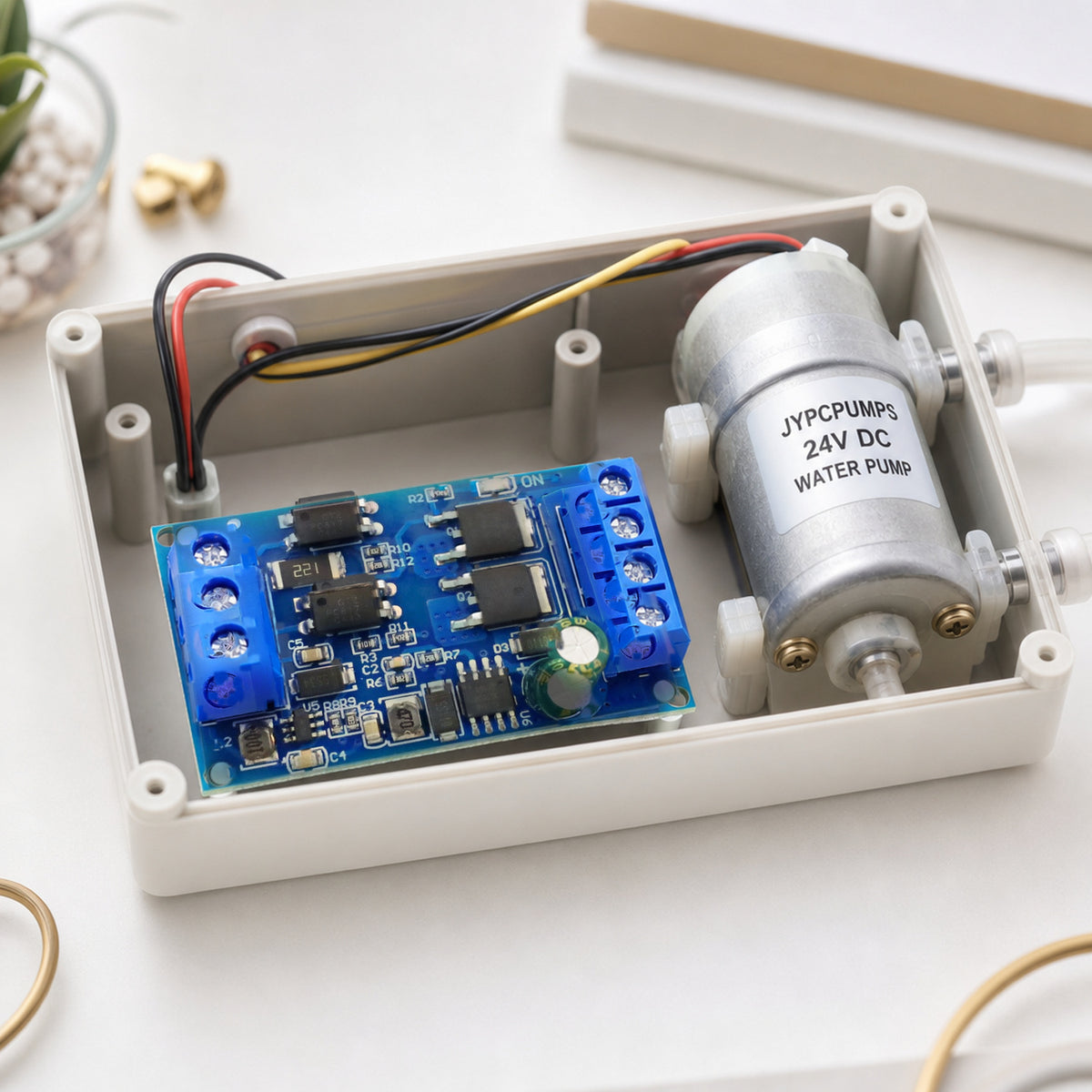
The high-power MOSFET PWM switch module is an isolated electronic switch board that lets a low-voltage signal from an Arduino, ESP32, Raspberry Pi, PLC or a plain switch turn on, turn off or PWM-dim a DC load of up to 10 A and 600 W, replacing a mechanical relay for motors, LED lighting, pumps, fans and heaters.
Isolated high-power switching module for driving DC motors, LED strips, lamps, pumps, solenoids and heaters from a microcontroller, PLC or a simple switch. Dual parallel MOSFETs deliver 10 A continuous (600 W) across a wide 4–60 V input range, and a PWM input (0–2.5 kHz) lets you control motor speed or lamp brightness directly. Optocoupler isolation protects your controller. Note: use only one trigger type at a time; keep high-level signals between 3.0–24 V and low-level signals below 0.6 V.
What can you use it for?
- Speed control of DC motors, fans and water pumps with a PWM signal
- Dimming 12 V / 24 V LED strips and lamps
- Switching heaters, solenoid valves, electromagnets and 3D-printer heated beds
- Silent, spark-free replacement for relays in automation and vehicle projects
- High-current output stage for Arduino, ESP8266/ESP32, Raspberry Pi and PLC controllers
Who is it for?
Electronics hobbyists, automation engineers, students and repair shops that need a ready-made high-current switch without designing a MOSFET driver circuit.
Compatibility
- Signal sources: 3.3 V / 5 V microcontroller pins (Arduino, ESP32, Raspberry Pi, STM32), PLC outputs, 12–24 V control lines, mechanical switches
- Loads: any DC load from 4 V to 60 V up to 10 A continuous (15 A with extra cooling), 600 W maximum
- PWM: 0–2.5 kHz signal frequency for motor speed or LED brightness control
Specifications
| Operating voltage | DC 4–60 V |
|---|---|
| Continuous current | 10 A at room temperature (up to 15 A with extra cooling) |
| Max power | 600 W |
| Trigger modes | High-level (DC 3.0–24 V), low-level (DC 0–0.6 V), dry-contact switch, PWM |
| PWM frequency | 0–2.5 kHz |
| Isolation | Optocoupler-isolated signal input |
| Output stage | Dual parallel MOSFETs, active output, low RDS(on) |
| Operating temperature | −40 to 85 °C |
| Board size | 46.5 × 29 × 12 mm, 2 mm mounting holes |
| Indicator | ON LED shows output state |
What's in the box
- Default Title: 1 × MOSFET PWM switch module with screw terminals
Frequently asked questions
Can I control this module with an Arduino or ESP32?
Yes. Connect a 3.3 V or 5 V output pin to the high-level trigger input and GND to signal ground. A PWM pin lets you vary speed or brightness.
What is the maximum load?
10 A continuous at room temperature and 600 W total, on any supply voltage between DC 4 V and 60 V. With a heatsink or fan the module handles up to 15 A.
Does it work with 12 V and 24 V loads?
Yes. 12 V and 24 V motors, LED strips, pumps and fans are the most common use; anything from 4 V to 60 V DC is supported.
Is the input isolated from the load?
Yes. An optocoupler separates the control signal from the power side, protecting your microcontroller from the high-current circuit.
Can I use AC loads?
No. This is a DC-only MOSFET switch. For AC lamps or appliances use a solid-state relay instead.
What is the difference between high-level and low-level trigger?
High-level trigger switches on with 3.0–24 V on the input; low-level trigger switches on when the input is pulled to 0–0.6 V. Use only one trigger method at a time and avoid signal voltages between 0.6 V and 3.0 V.
Share